



TSE Asia Startup Hub
CDIB Capital Group
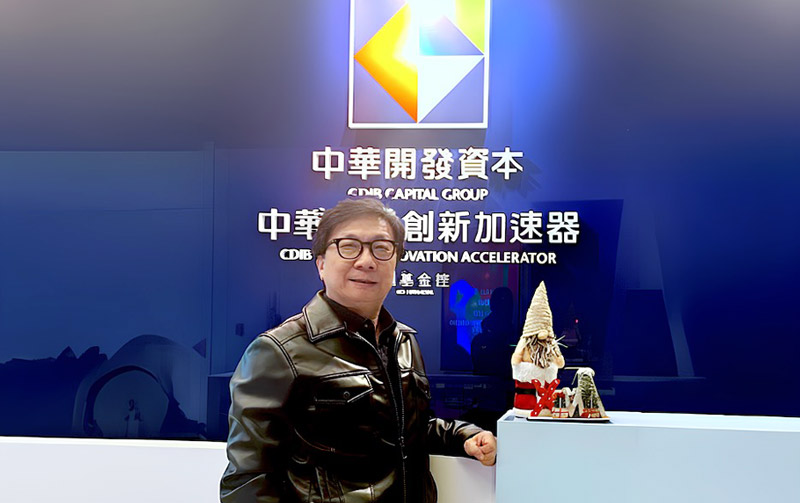
Ryan Kuo, President of CDIB Capital Innovation Accelerator (CCIA) Photo credit: CDIB Capital Group
Why Taiwanese Startups Choosing Tokyo
CDIB Capital Innovation Accelerator (CCIA) has emerged as a key player connecting Taiwan's startup ecosystem with the Japanese market. The company's predecessor was established in 2015, with accelerator activities beginning in 2017, now entering its eighth year. As part of Taiwan's major financial group CDIB Capital Group*, CCIA has focused on startup investments and cross-border expansion support. Most notably, its intensified efforts in the Japanese market since 2023 have presented Taiwanese startups with a new option: IPOs on Japanese stock exchanges.
Leading CCIA's deepening collaboration with the Tokyo Stock Exchange (TSE) is Ryan Kuo, who brings extensive experience in Taiwan's venture capital industry. With a deep understanding of both Japanese and Taiwanese business cultures, Kuo serves as a bridge between the two markets. As multiple portfolio companies, including KKday, consider expansion into or listing on the Japanese market, CCIA's strategy offers an important pathway for Taiwanese startups.
Through this interview with Kuo, we explore why Taiwanese startups are choosing the Japanese market, the challenges of cross-border investment, and CCIA's vision for the future.
Building Trust with Tokyo Stock Exchange
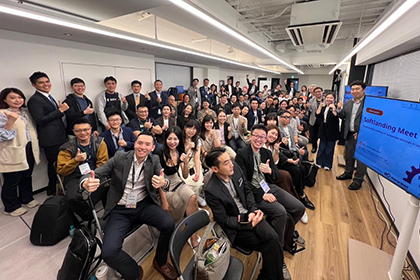
Taiwanese startups gathered at the CDIB Tokyo Innovation Hub in Ichigaya, Tokyo, in May 2024 as part of a Japan visit program aimed at deepening understanding of the Japanese market. More than 30 startups from Taiwan participated. Photo credit: CDIB Capital Group
CCIA's involvement with the Japanese market dates back several years. Kuo's team began building relationships with Japanese partners—major banks and major accounting firms—to understand Japan's capital markets. This wasn't mere networking, but a strategic move to chart a concrete path for Taiwanese startups to list in Japan.
Central to these efforts was organizing delegations of Taiwanese startups to visit Tokyo. CCIA led these delegations for two consecutive years, visiting the Tokyo Stock Exchange and major banks while conducting workshops. Participating executives received direct advice from accountants and financial experts, learning about Japan's unique business practices and regulatory environment.
"We've continued this delegation program for two consecutive years. Through this, I believe the TSE has come to understand that we're serious about this initiative and genuinely want to bring Taiwanese startups to the Japanese market," says Kuo.
This program meant more than just information provision. It was an educational investment for Taiwan's entire startup ecosystem. Not all participating companies would immediately list in Japan, but through this experience, understanding of the Japanese market spread throughout Taiwan's entrepreneurial community. This long-term perspective is characteristic of CCIA's approach.
However, CCIA's selection as a partner was likely not solely due to these steady efforts. Another important factor was the quality and breadth of its portfolio. Many Taiwanese companies that TSE was eyeing as potential listing candidates were already CCIA portfolio companies.
KKday, Taiwan's major travel platform, is a prime example. Founded in 2014, KKday has grown into one of the Asia Pacific region's largest online travel experience booking platforms, with significant business in Japan. CCIA invested from its early stages, supporting its growth. Beyond KKday, multiple portfolio companies including fintech firm 21st Fintech are being considered as TSE listing candidates.
"Our coverage is very extensive. This isn't by chance—it's the result of identifying and supporting companies with global expansion potential from early stages," Kuo explains.
Interestingly, IPOs by Taiwanese startups in Japan haven't yet become mainstream. So far, only one Taiwanese company has listed in Japan: Appier. However, this isn't because market potential is limited. Rather, it's because appropriate preparation and support systems weren't in place. The partnership between CCIA and TSE aims to change precisely this situation.
Why Japan?

At the Meet Taipei startup conference in November 2022, CCIA and startup support organization Garage+ jointly operated a booth focused on supporting Taiwanese startups' expansion into Japan. The author also delivered a presentation. Photo credit: CDIB Capital Group
For startups, which stock exchange to list on is a strategic decision that transcends mere fundraising. As globalization advances, Taiwanese startups have multiple options: NASDAQ, Singapore Exchange, Hong Kong Exchange, and both Taiwan Stock Exchange and Tokyo Stock Exchange. Each market has unique characteristics, and the optimal choice varies depending on a company's business strategy, growth stage, and future vision.
"First, we must understand that different capital markets have different types of investors. Market selection requires comprehensive consideration not just of listing ease, but of the recognition, liquidity, and long-term synergies available in that market," Kuo notes.
NASDAQ remains attractive to many Taiwanese startups, but Kuo offers a realistic perspective.
"The company size that NASDAQ investors expect is very large. Unless enterprise value exceeds $1 billion, you can't be considered an attractive investment target. Even if you manage to list on NASDAQ, without business operations in the US market, you won't gain recognition. If analysts don't cover you, investors won't pay attention, and liquidity will remain low," Kuo explains.
So why have Taiwanese startups recently begun focusing on the Japanese market? Kuo explains with concrete examples.
"Take KKday as an example. They already operate large-scale business in Japan. If they list in Japan, they gain credibility as a listed company, making partnerships with other Japanese companies easier. This has value beyond simple fundraising," says Kuo.
According to Kuo, there's been a clear shift in market preferences over the past two years.
"Until two years ago, the US market was the first choice, with Japan second. But since last year, that order has reversed. Now, Japan has become the top priority market for many Taiwanese startups," Kuo reveals.
Behind this change is the evolution of Taiwanese companies' global strategies. Many companies have adopted a strategy of first establishing position in the Asia Pacific region, then gradually expanding globally. Within this, Japan stands as one of the most attractive markets in terms of market size, purchasing power, and business environment maturity.
Furthermore, TSE's listing standards are realistic for Taiwanese startups.
"If valuation is around $200 million, it's entirely manageable. Of course, below $200 million there may be liquidity challenges, but companies doing business in Japan should have reached a certain scale. Additionally, becoming a listed company in Japan makes recruiting excellent talent easier. You can recruit talented Japanese personnel more easily, and they'll support business expansion, enabling further growth," Kuo notes.
What about listing in Taiwan? Kuo acknowledges Taiwan market advantages while raising an important question.
"Compared to Japan, IPO in Taiwan is easier. For Taiwanese companies, it's their home market, so they're familiar with regulations, and listing standards are relatively relaxed. In fact, in Taiwan, companies with valuations exceeding $100 million can list even if unprofitable. But will Taiwan's capital market support business expansion outside Taiwan? If you plan to operate business only within Taiwan, listing in the Taiwan market is a reasonable choice. However, if you're considering global expansion, especially expansion into the Japanese market, listing in Japan is worth considering," Kuo suggests.
Three Walls to Success
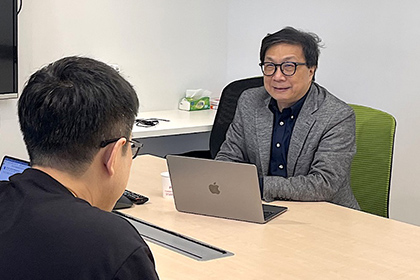
Ryan Kuo Photo credit: Growthstock Pulse
After discussing the appeal of the Japanese market, Kuo spoke candidly about realistic challenges Taiwanese startups face.
"For us, these are opportunities rather than challenges. However, I must acknowledge there are many challenges for our portfolio companies. In expanding business in Japan, building local business is extremely important. And the key to achieving that is talent," Kuo states.
For foreign companies, talent acquisition in Japan is more difficult than imagined. Particularly, securing senior-level talent who can be immediate assets in business development and sales is a major challenge.
"As a foreign company, recruiting excellent talent in Japan is truly difficult. Especially finding senior-level talent who understand the Japanese market and can develop business is a major challenge," Kuo confirms.
The second challenge is organizational culture unique to Japanese companies.
"In Japan, hierarchical organizations are common. The problem is, when you first contact business people at the ground level, they tend to be reluctant to adopt foreign products or services. They always prefer domestic products," Kuo explains.
This is a typical challenge many foreign companies experience in the Japanese market. Japanese companies' decision-making processes often proceed bottom-up, but final authority rests with upper management. However, if turned away at ground level, proposals never reach upper management.
Kuo's suggestion is a more strategic approach.
"It's important to connect directly with higher-level people—those who can think from a long-term perspective. They can understand long-term value, not short-term profit. For that, you need appropriate networks, introductions, and trust relationships," Kuo advises.
The third challenge Taiwanese startups face in Japan is, surprisingly, related to fundraising.
"Japanese venture capital firms, especially Japanese companies, tend to prefer investing in Japanese startups. Finding Japanese VCs that invest in foreign startups is very difficult. Many Japanese VCs have agreements with their LPs at fund establishment not to make investments outside Japan," Kuo reveals.
This is a major problem for foreign startups trying to enter the Japanese market. Typically, when startups enter new markets, receiving investment from local VCs plays an important role in establishing market credibility. However, in Japan this path is often closed.
"Currently, foreign venture capital firms are mainly investing in foreign startups in Japan. This isn't a good situation. If Japanese local VCs can invest in foreign startups, a positive cycle will emerge," Kuo notes.
Beyond Tokyo: The Fukuoka Play

A view of Fukuoka City seen from Momochihama Photo credit: Nryate via Wikimedia CC BY-SA 4.0
Essential to discussing CCIA's Japan strategy is its expansion into Fukuoka. While many foreign companies concentrate in Tokyo, CCIA has made the seemingly surprising choice of also establishing an office in Fukuoka, the central city of Kyushu region. However, for Kuo, this is a well-calculated strategic move.
"We currently have spaces in both Tokyo and Fukuoka," says Kuo.
Fukuoka has been selected as one of the "Startup Ecosystem Hub Cities" promoted by the Japanese government, with lower business costs compared to Tokyo and substantial local government support. Geographically, it's close to Asia's major cities, with access from Taiwan comparable to Tokyo. Another reason CCIA expanded to Fukuoka is the potential of the entire Kyushu region. Kyushu has regions with strengths in specific fields scattered throughout, such as Kumamoto known as a semiconductor industry cluster, and Kitakyushu as a biotechnology hub. By partnering with companies and research institutions in these regions, Taiwanese startups may find new business opportunities.
"Fukuoka has a different ecosystem from Tokyo. In Tokyo, partnerships with major corporations and global companies are central, but in Fukuoka, partnerships with regional mid-sized companies and companies with strengths in specific fields are possible. For Taiwanese startups, this represents new growth opportunities," Kuo explains.
This regional expansion strategy embodies CCIA's stance as "more than just a capital provider." By having two bases in Tokyo and Fukuoka, they can provide portfolio startups with more diverse market expansion options.
More Than Money
Photo credit: Growthstock Pulse
Listening to Kuo, it becomes clear that the role of modern venture capital has evolved from mere capital provider to comprehensive growth partner. CCIA's strategy embodies this evolution.
First is providing market understanding. The Japanese market has unique characteristics different from many Asian countries. Through years of experience in the Japanese market, CCIA has accumulated such "tacit knowledge."
Second is providing networks. Through partnerships with major banks, major accounting firms, and TSE, CCIA has built extensive connections with Japan's business elite. Portfolio startups can leverage this network to potentially accomplish in months what would normally take years of relationship building.
Third is providing strategic advice. On which market to list in, what timing to enter the Japanese market, whether to choose M&A or organic growth—on these important decisions, CCIA functions not as a mere advisor but as a partner jointly building strategy.
One of CCIA's distinctive initiatives is educational programs for Taiwanese startups.
"This is a kind of investment. Not all participating companies will ultimately list in Japan. However, through this program, understanding of the Japanese market deepens across Taiwan's entire startup ecosystem. From a long-term perspective, this educational investment strengthens the bridge between Taiwan and Japan's capital markets," Kuo explains.
Another aspect Kuo emphasizes is community building. Taiwanese startups expanding into Japan face common challenges. Connecting these companies and creating a community where they can share knowledge and experience is also part of CCIA's role.
The M&A Gambit
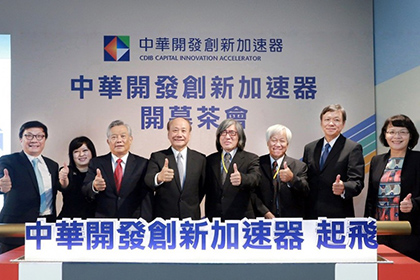
CDIB Capital launched its Innovation Accelerator in August 2017. The photo is from the opening ceremony. Photo credit: CDIB Capital Group
At the end of the interview, Kuo discussed future prospects. CCIA enters its eighth year this year. Building on what has been achieved, they're charting new strategies for the next stage.
"In eight years, we've steadily built a track record. We started with investments in early-stage startups. Now we have offices in Tokyo and Fukuoka, and have become an important player connecting Japan and Taiwan," says Kuo.
During this period, CCIA has invested in over 50 startups in Taiwan. Among them are cases like KKday, which is viewed as a potential next unicorn, as well as startups still in early stages.
The core of CCIA's next strategy is establishing an M&A fund. Until now, the company has focused primarily on equity investments in early-stage startups, but plans to launch an M&A fund for growth-stage companies.
"We're currently planning a fund specialized in cross-border M&A. This fund will support Japanese and Taiwanese startups in acquiring each other. We already have an M&A-specialized fund in Taiwan, but a fund specialized in cross-border M&A between Japan and Taiwan doesn't yet exist. We'll be the first," Kuo announces.
Behind this strategy is clear logic. For early-stage startups to grow and reach IPO typically takes about 10 years. However, leveraging strategic M&A could potentially shorten this process to about 5 years.
"For example, if a Taiwanese technology company acquires a Japanese company with sales channels, they can establish presence in the Japanese market far more quickly than entering from scratch. Conversely, cases where Japanese companies acquire Taiwanese technology companies are also envisioned. Japanese companies seek the technology and innovation that Taiwanese startups possess. Meanwhile, Taiwanese startups seek access to the Japanese market. M&A is a solution that can simultaneously satisfy both parties' needs," Kuo explains.
This is also a powerful solution to the talent acquisition challenge mentioned earlier. Acquiring a Japanese company means obtaining excellent Japanese talent as a team, while simultaneously gaining an existing customer base and market knowledge.
"We want to make 1+1>2. The M&A we facilitate isn't just about acquiring companies. It's about how to integrate technology, markets, talent, and corporate culture to create new value. That's our expertise," Kuo states.
CCIA plans to provide comprehensive support leveraging its extensive experience and networks in both markets, from discovering appropriate M&A targets and due diligence to post-integration management support.
"In five years, multiple IPO stories will emerge from our portfolio companies. What's important is that many of those IPOs will come from our M&A strategy. For early-stage startups to reach IPO on their own takes too long. However, by leveraging an M&A fund, we can guide many companies to IPO in the short period of five years. This is our next milestone. Our goal is to have 15 portfolio companies in Japan and 15 in Taiwan. But it's not merely a numbers issue. What's important is creating synergies among these companies. By finding optimal combinations, we believe we can create more success stories," Kuo explains.
Reimagining Asian Capital Markets
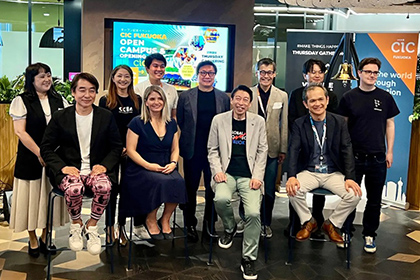
At the opening event of CIC Fukuoka, where CCIA established its Fukuoka office. Ryan Kuo is pictured at the center rear. Photo credit: CDIB Capital Group
What emerges through dialogue with Kuo is new dynamism in Asia's capital markets. Until now, the ultimate goal for Asian startups was always the US market, particularly NASDAQ listing. However, that structure is changing.
The Japanese market isn't merely an "alternative." For many Taiwanese startups, Japan has become the top priority market. This is due not just to geographical proximity, but to market size, business culture affinity, and above all, effects that lead to actual business growth.
However, to make this new flow a genuine trend, there are many challenges to resolve. The difficulty of talent acquisition, addressing hierarchical organizational culture, promoting investment by Japanese VCs in foreign startups—these are the concrete challenges Kuo identified. To truly attract global startups, these challenges must be addressed sincerely.
The vision Kuo envisions—two bases in Tokyo and Fukuoka, providing comprehensive growth partner value beyond capital, rapid growth through M&A, integration of Japan and Taiwan's startup ecosystems, and realizing multiple IPOs within five years—is by no means a pipe dream. The foundation is already built, and the possibility of this becoming reality in the next five years is high.
"We're working from a long-term perspective. The seeds we plant today will become large trees in 5 or 10 years. Believing in that, we continue fulfilling our role as a bridge between Japan and Taiwan," Kuo concludes.
Asia's capital markets are about to enter a new era. We can't take our eyes off the future developments of Ryan Kuo and CCIA, who are active at the center of it all.
This article is a summary of the interview published on Growthstock Pulse. See also the full interview: Part 1 and Part 2.
