



TSE Asia Startup Hub
IMM Investment Japan Corp.
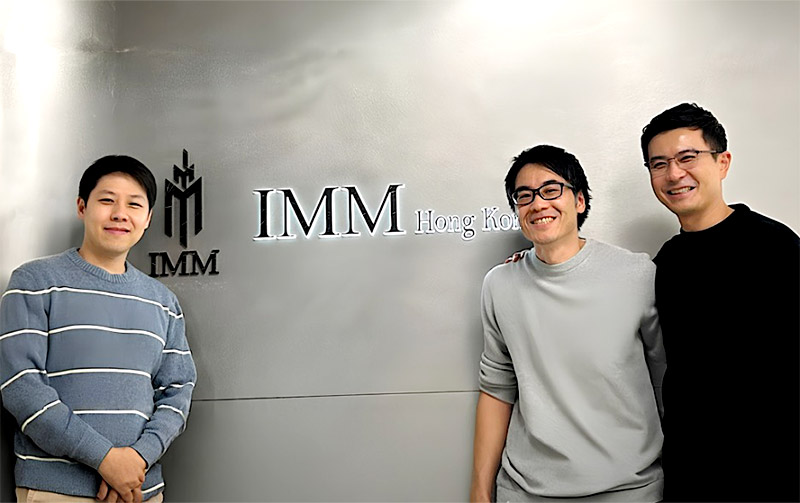
From left: John Yoon (Managing Director, IMM Investment), Harutaka Imaizumi (Chief Investment Officer, IMM Investment Japan), Youngjoon Lee (CEO and Managing Director, IMM Investment Hong Kong) Image credit: IMM Investment
IMM Bridges Japan-Korea Startup Ecosystems with 26-Year Corporate Networks
The Tokyo Stock Exchange is spearheading the TSE Asia Startup Hub program, an initiative designed to connect startups across Asia with the Japanese market and promote mutual growth. Among the participants is IMM Investment*, one of Korea's leading venture capital firms.
Harutaka Imaizumi, who leads investment activities at IMM Investment Japan, has experience at Innovation Network Corporation of Japan (INCJ, a government-backed investment fund) and has been working to build an investment ecosystem connecting Japan, Korea, and Taiwan.
His approach goes beyond simple capital provision—it's a growth strategy based on organic collaboration among Asian companies. By combining Japan's superior technology seeds with the manufacturing capabilities and market development strengths of Korean and Taiwanese corporations, he accelerates startup growth.
In this article, we spoke with Imaizumi about IMM's investment philosophy, its unique investment style involving collaboration with large corporations, focus areas in the Japanese market, and expectations for the TSE Asia Startup Hub.
Overwhelming Presence of Korea's No.1 VC
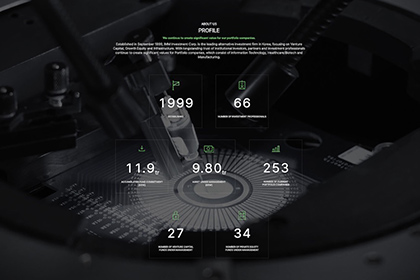
IMM Investment's track record as displayed on their website (Note that figures are shown in Korean Won on the site but expressed in USD in this article) Image credit: IMM Investment
Since its founding in 1999, IMM Investment has carved out a distinctive position in Korea's venture capital industry. Its current AUM exceeds $7.6 billion as of September 2025. This scale is unmatched in Korea's VC industry.
The company's investment scope is extremely broad. It covers the entire corporate lifecycle from venture capital (seed and early stage) to growth capital (middle and later stages) to infrastructure investment.
"IMM Investment Group has the largest private VC management scale in Korea or East Asia (Editor's note: No.1 in total AUM in Korea), and we have been able to respond to investments in all asset classes and industries," says Imaizumi.
IMM's overseas expansion has also been aggressive. After its founding in Korea, it established Japan as its first overseas base, and now has offices in Hong Kong, Singapore, and India. Japan in particular has been an important strategic base since IMM's entry in 2017.
The composition of Limited Partners (LPs)—the sources of investment funds—is also distinctive. Forty percent consists of public pension funds, 10% is government-affiliated financial institutions such as the Korea Development Bank (KDB), and the remainder comprises institutional investors. While the proportion of strategic LPs (operating companies) is small, numerous Korean operating companies are participating. These operating companies seek opportunities for collaboration with IMM's portfolio startups through their investment in IMM's funds. They are not mere capital providers but strategic partners playing important roles in IMM's investment strategy.
Unique Investment Style Created Through Corporate Collaboration
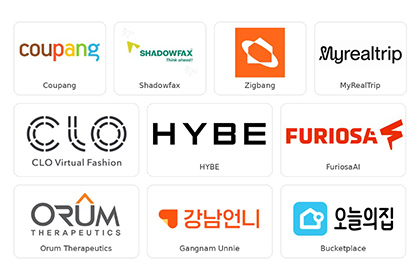
Some of IMM Investment's portfolio companies (including companies that have already exited) Image credit: Growthstock Pulse
IMM's greatest distinguishing feature lies in its close collaborative structure with large corporations throughout the investment process. While typical VCs conduct matching with large corporations as value-add activities after investment, IMM involves large corporations from the pre-investment stage.
Among these companies, some are strategic LPs that have invested in the fund, while others are not LPs but cooperate as business collaboration partners. In either case, a relationship has been established where they consult from the pre-investment stage on whether they can actually do business with the startups IMM is considering for investment.
"For us, it's also investment risk hedging, but we ask our partner companies to conduct business due diligence. We reach out to industry leaders and confirm what interest they have in the startups we're considering for investment. We only execute the investment after gaining confidence that we can build the business. By having a broad network with large corporations, we can conduct high-probability activities both in investment activities and in subsequent business building activities. This is precisely IMM's unique point that other VCs don't have," says Imaizumi.
This bidirectional relationship has been built over 26 years. IMM supports large corporations' global expansion, and large corporations boost the growth of IMM's portfolio startups. This ecosystem creates IMM's competitive advantage in Korea's startup scene.
Bridging the Gap Between Technology and Markets
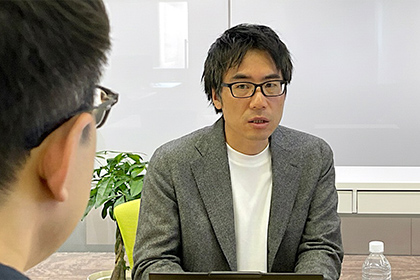
Harutaka Imaizumi, Chief Investment Officer (CIO), IMM Investment Japan Photo credit: Growthstock Pulse
Behind IMM's entry into Japan in 2017 lay clear strategic judgment.
"Japan has very good academic seeds, technology, and services. However, unfortunately, over the past 20-30 years, Japanese large corporations' global presence has relatively declined. As a result, there have emerged industries where startups no longer have customers within Japan," says Imaizumi.
This observation is particularly evident in the semiconductor industry. In the 1990s, six Japanese companies were among the world's top 10 semiconductor manufacturers. However, the situation has completely changed, with Korea's Samsung and SK and Taiwan's TSMC now showing overwhelming presence in the global market.
"There are very good technologies related to semiconductors, both in materials and manufacturing equipment. However, the position of Japanese companies that would utilize them has declined. Therefore, we thought we could create growth opportunities for Japanese startups by connecting such Japanese technology with Korean and Taiwanese companies that would use them as customers," says Imaizumi.
This strategy represents value creation beyond simple intermediation. Japanese startups gain solid customers in the form of Korean and Taiwanese corporate giants and establish footholds in the global market. Meanwhile, Korean and Taiwanese companies access Japan's cutting-edge technology and strengthen their competitiveness.
"Foreign funds like ours must have some strength, or our raison d'être in Japan would diminish. Our overwhelming strength that other Japanese VCs don't have is our Korean network. We have absolute confidence that no one can beat us in this area. Leveraging this strength, we concentrate our investments in areas where this strength actually functions," says Imaizumi.
In the IT field, while Korea has prominent companies, they are not necessarily seen as optimal connection points for Japanese startups in the context of future global collaboration. In contrast, the situation is significantly different in the semiconductor and electronic components field.
"I believe there are virtually no startups uninterested in collaboration with Samsung and SK. Acting as a hub in such areas is precisely what Japanese startups want from us, and we believe this is our value in the Japanese startup ecosystem," says Imaizumi.
IMM has established a unique position in the Japanese market by concentrating on areas where it has this clear advantage. The first fund conducted investment activities specializing in the hardware and deep tech sectors. The current second fund has expanded the scope of investment by adding the entertainment, media, and content sectors.
Two Focus Areas

Free images from Freepik
IMM has two focus areas in the Japanese market. One is hardware and deep tech, particularly semiconductors and electronic components. The other is entertainment, media, and content. Both are fields where Korean companies have global strengths and high affinity with the Japanese market.
In hardware and deep tech, the complementary nature of Japan-Korea-Taiwan industrial structures comes into play. Imaizumi leverages his experience from his previous role at INCJ, where he promoted collaboration with Taiwanese companies, and is now working on discovering and nurturing deep tech startups in the Kyushu area, also utilizing networks with regional financial institutions.
"We're supporting the overseas expansion of hardware and deep tech startups, particularly in semiconductors and electronic components, through collaboration with Korean and Taiwanese large corporations. In Kyushu, where the semiconductor industry is experiencing significant growth and collaboration with Taiwanese companies is advancing, we focus on supporting development and sales channel expansion through collaboration with Korean companies, regardless of whether they are startups or SMEs," says Imaizumi.
A characteristic of Korean deep tech startups is the prevalence of corporate spin-outs. Meanwhile, Japan can be considered to maintain a certain level of competitiveness in the depth of its basic research.
"I think Japan still has more power when it comes to creating something from academia," says Imaizumi.
The entertainment sector is a focus area that was added in earnest from IMM's second fund. This choice has a clear strategy with an eye toward listing on the Japanese market.
"Particularly in the entertainment sector, it's natural to appeal to institutional investors, but it's also important to appeal to individual investors. Creating fans of the startup in Japan becomes important," says Imaizumi.
When aiming for listing on the Japanese market, the evaluation axis is not limited to institutional investors. To attract the interest of individual investors, it's important that the business content is understood and resonates at the consumer level. The entertainment sector naturally satisfies this condition.
For example, in the electronic components sector, while Japan has cultivated technological and material foundations, it's Korean companies like Samsung, LG, and SK that have mastered using them as products and captured markets. A similar structure can be seen in the entertainment field, where the source of value and the players responsible for market deployment do not necessarily align.
"For large Korean corporations that have firmly captured the Japanese market, many cases involve direct entry by themselves. However, with the recent increase in startups spinning out from large corporations, collaboration with Japanese platforms and large corporations becomes important to accelerate speed. We're going to facilitate those connections," says Imaizumi.
Turning Recognition Into Real Opportunities

Korean startups are concentrated in Gangnam, Seoul. Photo credit: Elina Volkova, Free image via Pexels
Regarding the TSE Asia Startup Hub, Imaizumi, as an investor and program partner, highly values the initiative itself. Traditionally, stock exchanges have been in a position to wait for companies to list, with limited opportunities to officially engage with pre-IPO startups. The attempt by a stock exchange to officially introduce startups from Asian countries and create touchpoints with the Japanese market is clearly a new approach.
"The fact that a stock exchange officially displays the logos of startups that are neither listed nor certain to list in the future—this is a very bold step forward," says Imaizumi.
However, Imaizumi points out that there are several challenges to truly developing this program into "something of real value." What Imaizumi focuses on is not the selection itself, but what happens afterward.
"There are selected startups, but whether this leads to actual actions and business is important. Rather than just logos being displayed and ending there, participation creates concrete change. I think creating such a state is important," says Imaizumi.
Imaizumi offers suggestions from three perspectives. First is strengthening business building support in the Japanese market. Many participating startups are at a stage before considering listing. For them, the top priority is actually establishing business in the Japanese market.
"Before thinking about listing, whether they can build business in Japan comes first. I think it's natural to support that aspect first, then connect it to listing support as the next step," says Imaizumi.
Second is creating mechanisms to substantialize partner company involvement. Currently, many companies participate in the program as partners, but Imaizumi points out that more proactive engagement is important.
"I think partner companies have room to support startups more actively. I would appreciate it if TSE could better prepare mechanisms that further support and encourage partners’ initiatives," says Imaizumi.
Third is encouraging actual business creation.
"Projects are born and sales are generated. I think if you could put a bit more effort into the part that leads to such substantial results, the significance of the program would change greatly. Rather than stopping at mere exchange or information dissemination, as cases accumulate of businesses actually moving forward, both the value for participating companies and the persuasiveness of the entire program should increase," says Imaizumi.
Imaizumi himself expresses willingness to actively engage in this initiative, stating that he wants to provide concrete value to participating startups by leveraging IMM's large corporate network and years of experience in business building support.
The TSE Asia Startup Hub is still in its early stages. To make it a place that generates even more substantial business opportunities, it is expected that each stakeholder takes a step forward from their respective position.
This article is a summary of the interview published on Growthstock Pulse. See also the full interview: Part 1 and Part 2.
