


Overview (Venture Funds)
What are Venture Funds?
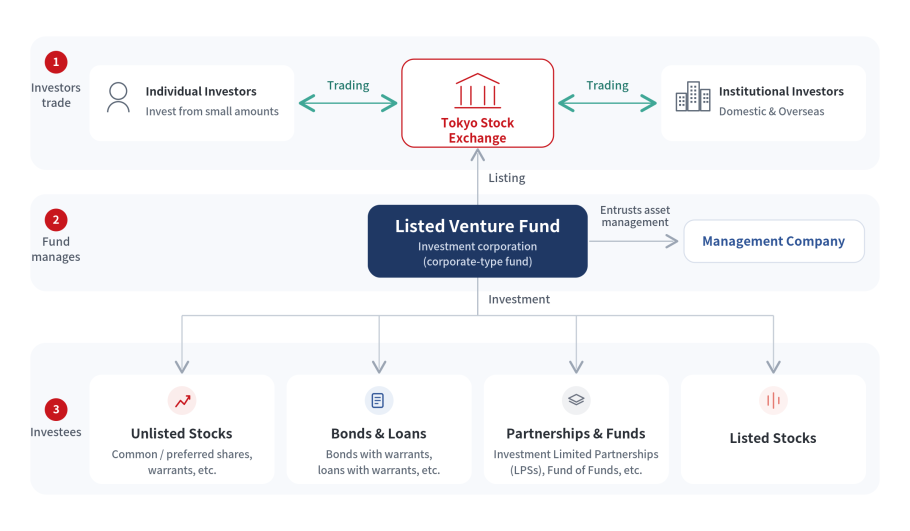
The Venture Fund Market was established in 2001 to diversify the channels through which capital is provided to unlisted companies. By listing funds with diversified portfolios of investments in multiple unlisted companies and other assets selected by professional asset management companies, the market provides investment opportunities to a broad range of investors, including individual investors. In recent years, the market framework has been further enhanced to encourage broader use of the market.
Access to Private Markets for a Broad Range of Investors
Traditionally, investments in unlisted companies have primarily been made through partnerships and similar vehicles, with institutional investors comprising the majority of investors. By enabling their investment securities to be traded on an exchange market, venture funds provide a broad range of investors, including individual investors, with opportunities to invest relatively small amounts in the growth of unlisted companies.
Long-Term Investment in Growth Beyond an IPO
Venture funds may be established without a fixed investment period or maturity date. By continuing to hold shares in portfolio companies after they go public, venture funds can support their subsequent growth over the long term. Because they can continue operating without being required to dissolve upon maturity, investors can pursue the medium- to long-term value growth of portfolio companies.
Transparency and Trading Opportunities Unique to an Exchange Market
Venture funds are subject to the disclosure framework of an exchange market, including periodic disclosure of information on their investment assets and net asset value per unit, as well as timely disclosure requirements. In addition, because their investment securities are traded on an exchange market, investors have opportunities to buy and sell their investment securities on an exchange market, even though the funds primarily invest in unlisted assets.
Diversified Investment in a Broad Range of Assets, from Unlisted Shares to Venture Debt
Venture funds may invest primarily in unlisted shares, as well as listed shares that they have continued to hold since before the relevant companies went public, and venture debt instruments such as bonds with stock acquisition rights and loans. They invest in a diversified range of portfolio companies and assets selected by the asset management company, seeking returns from increases in the value of portfolio companies. Depending on the fund’s investment strategy, they may also receive income such as dividends and interest.
Access to a Variety of Domestic and Global Investment Strategies
Venture funds enable individual investors to invest in areas that may otherwise be difficult for them to access directly. Asset management companies employ a variety of approaches in Japan and overseas, ranging from direct investments in unlisted companies to fund-of-funds (FoF) strategies that combine investments in other funds. By selecting funds based on their respective policies and features, investors can gain access to a diverse range of investment strategies.