


Cross-Border IPO
Innovacell Inc.
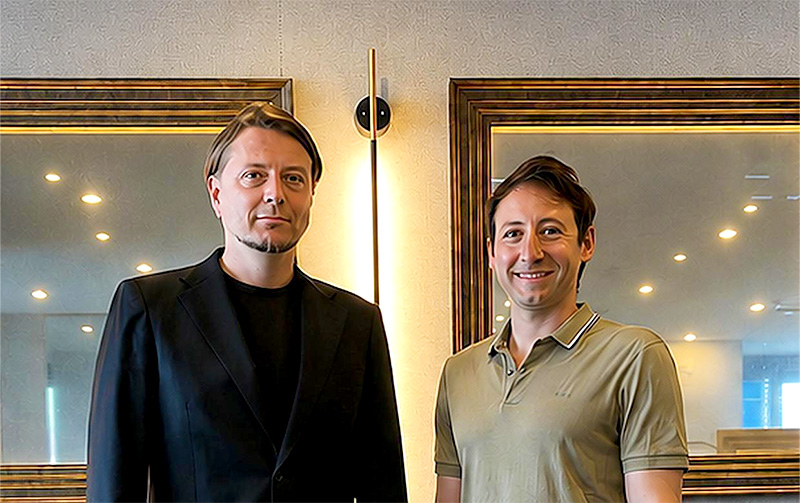
From left: Colin Novick and Jason Sieger, Co-CEOs and Representative Directors of Innovacell Photo credit: Growthstock Pulse
Japan as Headquarters, Not Just Market: 25 Years Behind Innovacell's Tokyo Listing
On 24 February 2026, Innovacell* listed on the Tokyo Stock Exchange Growth Market. The company's roots are a cell-therapy biotech spun out from the Medical University of Innsbruck in Austria in 2000. In 2021 it carried out a corporate inversion through a triangular merger, restructuring the group so that a newly founded Japanese entity became the parent, and then listed in Japan.
Foreign companies commonly look at Japan as a market. Few choose it as headquarters. And what this company develops is a regenerative medicine product for fecal and urinary incontinence — conditions neither patients nor doctors care to discuss.
Why did an Austrian university spin-out decide to become a Japanese company? Why the Tokyo Stock Exchange? We asked Co-CEOs and Representative Directors Colin Novick and Jason Sieger.
“Sending in mercenary myoblasts” — 25 years, and a company that nearly vanished
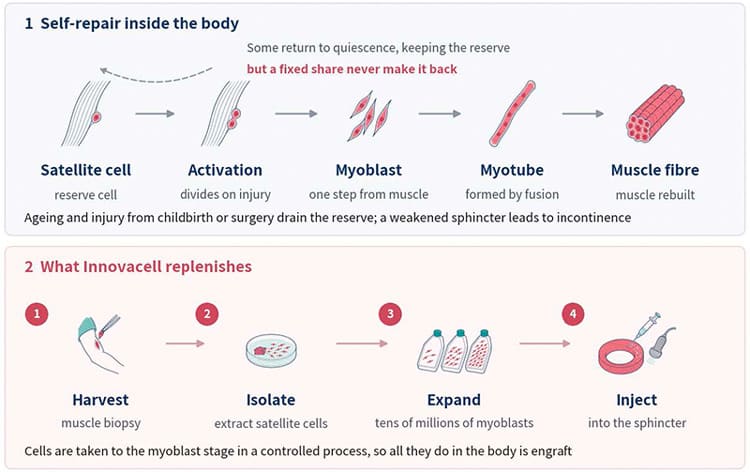
The body's repair cycle, and the steps at which Innovacell intervenes Image credit: Growthstock Pulse
Asked to describe in one line what Innovacell makes, Novick put it this way.
“In short, we dose patients with mercenary myoblasts.” (Novick)
Skeletal muscle fibres are surrounded by a reserve of quiescent cells called satellite cells. When muscle is damaged, they activate, proliferate as myoblasts, and either fuse to form new myotubes or engraft into existing fibres. When an activated satellite cell divides, one daughter cell is meant to return to quiescence and keep the reserve intact — but a certain proportion never make it back. Ageing and major injury, such as vaginal delivery or surgery, draw the reserve down; the sphincter weakens, and incontinence follows.
The therapy replenishes that reserve from the outside. A skeletal muscle biopsy is taken from the patient and sent to the manufacturing site, where satellite cells are isolated, taken to the myoblast stage, expanded to tens of millions and injected into the weakened sphincter. It is neither prevention nor symptom relief. It rebuilds the damaged muscle itself.
The technology begins in Innsbruck in the mid-1990s. Rainer Marksteiner — then a postdoc in the urology department of the Medical University of Innsbruck, now the company's chief scientific officer — and two professors asked whether, rather than physically supporting the urethra as the treatments of the day did, the muscle itself could be made to recover. What turned the idea into a company was an accident: a local entrepreneurship contest. The two professors, as hospital staff, were ineligible. Marksteiner entered in their place, and won.
“It was momentum. I'm laughing as I explain it now, but that was the moment of ‘I want this to be real.' That was the trigger.” (Novick)
Innovacell Biotechnologie (now Innovacell GmbH) was founded in 2000. For several years it had revenue: under European law at the time, treating a patient with their own cells counted as medical practice rather than a medicine requiring approval. Then, in 2007, the European Union adopted the ATMP Regulation, and autologous cell therapy had to clear the same development bar as a prescription drug. The premise on which shareholders had invested collapsed. From around 2009 to 2014, management asked shareholders for money every year, and with every round the founders' own stake thinned.
From consultants to principals
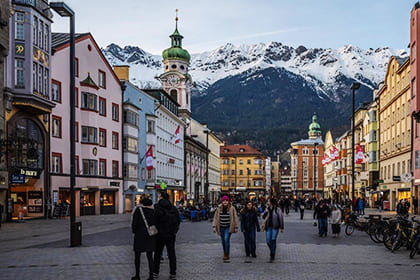
Development and manufacturing remain in Innsbruck. Maria-Theresien-Strasse and the Nordkette range Photo by Wilfredor via Wikimedia Commons, used under the CC0 license.
Novick was born in South Korea, Sieger in Hong Kong. Both came to Japan as small children and grew up there, began their careers at Tohmatsu Consulting (now Deloitte Tohmatsu Consulting), and went on to co-found CJ PARTNERS, an advisory firm specialising in regenerative medicine.
Their connection to Innovacell came by accident. Short of cash, the company had taken on contract manufacturing at its own GMP facility. One client, a Canadian company, was preparing for a face-to-face consultation with Japan's PMDA (Pharmaceuticals and Medical Devices Agency); CJ PARTNERS was preparing that package, while Marksteiner supported the Canadian side. A matter that had not moved after four meetings with a different advisor moved within a week. Back in Austria, he suggested to the then chief executive that they change advisers.
The relationship began in 2017 as advisory work, and Japanese investors came in at the end of 2019. A Japanese entity was incorporated in January 2021, and a triangular merger left it as the parent.
Asked about barriers to entry, Sieger pointed not to patents but to manufacturing cost. Where very few patients are eligible, a plant never runs full and cost per unit stays high. Innovacell has manufactured in its own GMP facility for more than 20 years and holds its cost at a low level. A company setting out to follow would also face five to ten years of clinical development.
“It's like a hidden moat. It is a moat, but there are leaves laid over the top, so it looks as though you could walk across.” (Sieger)
“Better a big fish in a small pond than lost in the crowd”
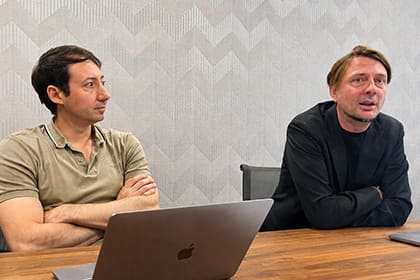
From left: Jason Sieger and Colin Novick Photo credit: Growthstock Pulse
The candidate venues were Europe, Japan and the United States. The deciding question was whether a market fits the company's equity story.
“NASDAQ and the New York Stock Exchange are very good markets. But to be valued by investors there you need a solid US equity story.” (Sieger)
Innovacell had not yet opened a clinical trial in the United States. Japan, by contrast, had the conditional, time-limited approval system introduced for regenerative medicine products in 2014, and development and approval looked achievable at least as fast as in Europe.
“When you list in America, only the huge successes get picked up, so people think that going to America will be fine. But the majority end up as part of the crowd. My view was that it is better to be a big fish in a small pond than to be lost in that crowd.” (Novick)
Both grew up in Japan and went through the Japanese school system, and have handled a great deal of PMDA work on regenerative medicine products. Being able to open up the black box that Japan is and show institutional investors what is inside — that skill set, Novick says, fitted this market best.
Japan then — but in what form? Becoming a Japanese company is not the only route; a Japanese Depositary Receipt allows a foreign company to list on the TSE as it is. A corporate inversion through a triangular merger is plainly the heavier route: persuading existing shareholders, tax, legal work, all of it. Which route fits depends on each company's shareholder structure and business strategy, but Innovacell chose to list as a Japanese company. Nomura Securities, the lead underwriter, raised the point, as did Yuki Ishida of YCP Holdings, a senior of Novick's at university who had himself listed in Japan via a JDR.
“Institutional investors separate funds that invest in Japanese equities from funds that invest in foreign equities. Which of the two a JDR falls into is sometimes not settled in their internal rules.” (Sieger)
The decision shows in the post-listing register. Because shareholders of the Austrian company became shareholders of the Japanese one after the triangular merger, foreign individuals hold a high 25.0% of Innovacell. But this is not a base of overseas retail investors. The company says the category is held by 49 people, most of them current and former management and parties related to them, and the securities report filed for the listing application shows that the two Co-CEOs and CSO Rainer Marksteiner together hold about 15% of shares outstanding.
A fan club, three years in the making
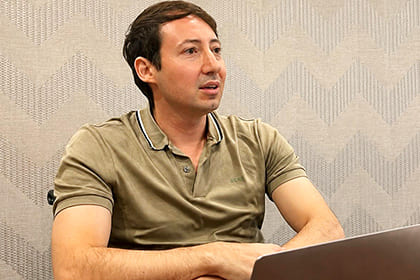
Jason Sieger Photo credit: Growthstock Pulse
A loss-making biotech with no revenue depends heavily on institutional feedback to price its IPO. In Japan, though, domestic institutions have long been said to keep away from biotech IPOs. When the company tallied 39 past prospectuses, the average pre-listing institutional holding came to 1.26%.
Innovacell had been working on that constraint from about three years before listing. We know we are not an investable name for you today, but let us introduce ourselves — in that form, Sieger says, they held conversations with a range of institutional investors. Asked whether this amounted to building a fan club, he nodded.
“If you meet someone for the first time and say ‘we want to do this eventually, so please invest,' there are cases where it simply isn't accepted. But if you have talked to them beforehand, they understand it as: those two have delivered everything on time and on budget since listing, so they will probably deliver this plan too. We want to lower that hurdle as far as we can.” (Novick)
Against the 1.26% average, Innovacell's pre-listing institutional holding was 9.63%. Institutional demand during the bookbuilding period reached about 100 billion yen, and proceeds came to about 11.7 billion yen. Overseas allocation was 45.1%. What the company intended was preferential allocation to long-only institutions rather than hedge funds.
“I think we managed to achieve a shareholder register and an offering structure that look as if we had listed on NASDAQ, while actually listing on the TSE.” (Novick)
Aggregation is attack, not defense
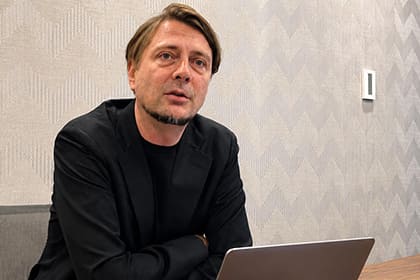
Colin Novick Photo credit: Growthstock Pulse
Looking back on the roughly six months since listing, Sieger says earning investors' trust as a company takes time. He also suspects many investors read a biotech as binary: a business that either succeeds or goes under.
“A biotech isn't zero or one. It's a game of removing risk factors one at a time and seeing how far you can raise the probability of success.” (Novick)
Removing risk factors one at a time means stacking clinical trials from Phase I through Phase III without skipping any. ICEF15 alone accounts for close to 600 patients enrolled across early trials and Phase III. The multiregional Phase III “Fidelia” trial is running in Europe and Japan, and US enrolment into the same trial will commence soon. At the time of the interview, enrolment stood at over 93% of a 290-patient target.
The second pillar is the “global aggregation model for cell and regenerative therapies” — a plan to find undervalued assets around the world and commercialise them on the platform the group has built. The three incontinence programs are its first instalment. Across three years of relationship-building with institutional investors, the model drew as much interest as the lead assets.
“They say: ‘given your track record, you could bring new assets in through the global aggregation model and develop them not just in Japan but across Japan, the US and Europe. It's that capability we're interested in.' If there's something good and you don't have the money to buy it, come and talk to us — we'll figure out a way to fund you. There are institutional investors saying that.” (Novick)
The model also lowers portfolio-wide risk. But the two call it attack rather than defense, because Japan has excellent technology and they have watched a great deal of it die for want of funding.
“It seems such a waste. Innovacell has the capability to develop globally, and we have our own manufacturing site. We have people who can evaluate technology. If we can put new assets onto this vehicle, I think we can create a structure where value goes up sharply at that moment.” (Sieger)
What Sieger and Novick are focused on is delivering, on time and on budget, what was promised at the listing: opening a clinical trial in the United States, settling on a partner. Do that, they expect, and the investor fan club built over three years will begin to pull.
This article is a summary of the interview published on Growthstock Pulse. See also the full interview: Part 1 and Part 2.
