



TSE Asia Startup Hub
Insignia Ventures Partners
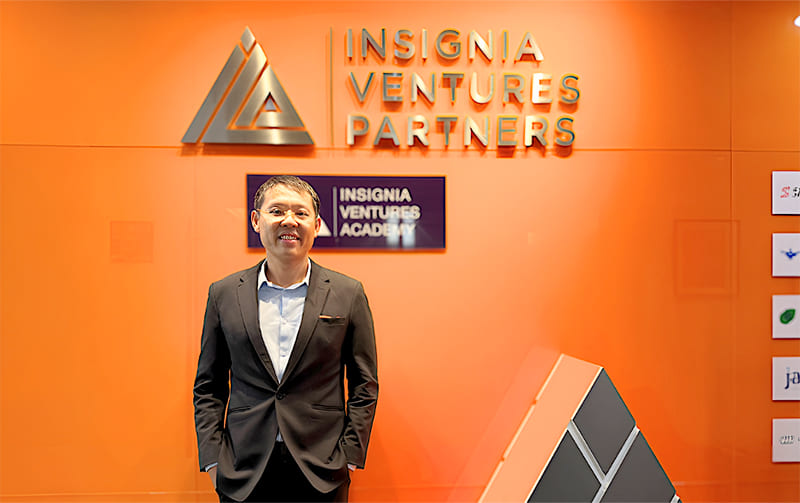
Yinglan Tan stands before Insignia Ventures Partners office. Photo credit: Insignia Ventures Partners
How Insignia Ventures Connects Southeast Asia to Japan's Capital Markets
The TSE Asia Startup Hub program, launched in 2024, has selected 20 supported companies (as of February 2026). Among participating venture capital firms, one stands out with an exceptional track record: Singapore-based Insignia Ventures Partners* has the most portfolio companies selected for the program—five in total—and has already achieved one TSE listing.
"The Japanese market is the most important market outside of Southeast Asia for our portfolio companies." (Tan)
We spoke with Yinglan Tan, Founding Partner of Insignia Ventures Partners, about the firm's strategy to connect these two markets bidirectionally and the new vision for capital markets that the TSE is pursuing.
Insignia's Secret Weapons: Unicorn Club, AI, and Academy

Insignia Ventures Academy trains and cultivates future venture capital professionals. Photo credit: Insignia Ventures Partners
Yinglan Tan represents a new generation of investors in Southeast Asia's venture capital industry. After earning a dual degree in Electrical Engineering and Economics from Carnegie Mellon University, he completed a Master's in Management Science from Stanford University and a John F. Kennedy Fellowship at Harvard University.
Following his work on innovation policy for the Singapore Prime Minister's Office and the Ministry of Trade and Industry, he became Sequoia Capital's first venture partner in Southeast Asia, leading early-stage investments in future unicorns including Tokopedia, Go-jek (now GoTo), Carousell, and Appier. In 2017, he founded Insignia Ventures Partners, investing in over 90 companies across Indonesia, Vietnam, Singapore, Taiwan, and other markets, with total assets under management reaching approximately S$1 billion (approximately US$750 million). However, Tan emphasizes:
"Our true strength goes beyond the size of our capital." (Tan)
He outlines four unique differentiation factors.
First is the existence of a "Unicorn Founder Club" with over 90 members. This informal network includes founders from established tech giants like Airbnb and Tencent to major Southeast Asian unicorn executives, playing crucial roles in introducing new deals, supporting due diligence, and creating exit opportunities.
Second is the thorough use of AI by their in-house technology team. The firm's investment committee includes a virtual AI investment committee member that evaluates deals on a scale of 1 to 10 based on years of accumulated data. An AI analyst automatically reaches out to promising founders on LinkedIn, and the team can generate drafts of term sheets and shareholder agreements in 10 seconds.
"We mandate all team members to implement AI workflows. At least in the early stages, we don't even need to engage law firms." (Tan)
Third is talent development through "Insignia Ventures Academy," which has already produced over 250 graduates, many of whom have joined Insignia's portfolio companies or taken on C-suite roles such as CFO. Alumni include individuals who transitioned from being a firefighter to joining a sovereign wealth fund position, a woman from a Japanese trading company who launched a pan-Asia fund, and even someone who rose through six promotions at another Japanese trading house to become Group CEO.
Fourth is continuous company incubation.
"Even as we've grown larger, we continue to incubate companies in areas where we see untapped areas for industry and market transformation." (Tan)
Business ideas emerge from the Unicorn Club, talent trained at the Academy executes them, and the technology team supports them with tools—this cycle forms the core of Insignia Ventures Partners' competitive advantage.
Appier: Template for Success
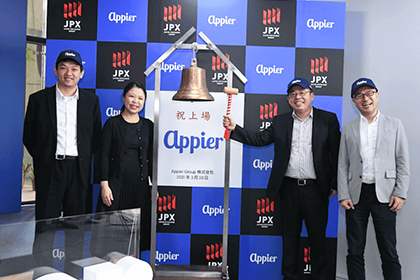
Appier went public on the Tokyo Stock Exchange in 2021. Photo credit: Appier
Insignia Ventures Partners' full-scale partnership with the TSE began with Appier's success. The relationship with Appier dates back to when the company still depended on Taiwan for 70% of its revenue. Tan advised the founding couple—CEO Chih-Han Yu and COO Winnie Lee:
"Taiwan is a small market. You need to find a larger market." (Tan)
Heeding that advice, the founding couple threw themselves into developing the Japanese market, and Japanese operations eventually grew to account for approximately 40% of total company revenue.
Tan's support began with network building. He introduced Yoshiyuki Shibusawa (then President & CEO of JAFCO Investment (Asia Pacific)) to Appier, who in turn introduced many Japanese companies to the firm. Tan then arranged a meeting with Masayoshi Son of SoftBank, leading to SoftBank's investment in Appier. With prominent Japanese investors including JAFCO and SoftBank on the cap table, Appier's presence in the Japanese market dramatically increased.
Subsequently, a Japanese CFO was hired and each hurdle of the audit and tax compliance required for corporate inversion (relocating headquarters to Japan) was cleared one by one. Lead underwriters were selected, establishing the relationship with the TSE. In March 2021, the listing ceremony was held via online broadcast due to COVID-19, with the founding couple celebrating by ringing a specially commissioned gong in Taipei. This success opened the path to full-scale partnership with the TSE.
Appier's success demonstrated a replicable model for conquering the Japanese market. According to Tan, there are three reasons why the Japanese market is attractive to Southeast Asian companies.
First is market size. Southeast Asia is fragmented across 10 countries, with different languages, religions, and payment systems. Except for Indonesia, each country's market is relatively small. In contrast, Japan is large as a single market with high GDP per capita.
Second is payment capability and reliability.
"Japanese companies pay for software services and pay on time." (Tan)
For companies operating B2B services, this is a decisive attraction.
Third is the presence of deep capital markets. The TSE has world-class liquidity, and its Growth Market opens doors to growing companies. For unicorn-class companies, it's an option second only to NASDAQ, while for mid-tier companies it offers appeal as a primary market.
However, Tan adds an important caveat:
"Breaking into the Japanese market takes time, but once you succeed, it becomes a very large market. What we learned from Appier is that 'patience' is essential." (Tan)
Three Barriers and True Localization

Free Stockphoto via PhotoAC
Following Appier's success, Insignia Ventures Partners became a partner of the "TSE Asia Startup Hub," and currently five of its portfolio companies have been selected for the program. However, for Southeast Asian companies, the biggest barrier to entering the Japanese market isn't language alone.
"To understand the Japanese market, you need to know three words: Nemawashi (consensus building), Jinmyaku (networks), and Nominication (drinking communication)." (Tan)
Nemawashi is the custom of individually coordinating with all stakeholders before decision-making.
"In China, the boss is the boss. If you talk to one person, it's decided. But in Japan, there is usually agreement by consensus so you need to get the buy-in of the entire group." (Tan)
You need to secure advance agreement from all investment committee members, and sometimes even working-level staff. Jinmyaku is a matter of "who vouches for you"—in Appier's Japan market entry, the roles played by Shibusawa and Son were not merely as capital providers but as "guarantors of trust."
"If Shibusawa-san vouches for you, that's proof of trust. If Son-san vouches for you, it's even more powerful." (Tan)
Nominication means that business venues aren't limited to conference rooms—a custom that differs significantly from Southeast Asia.
"Localization isn't just translation. To adapt products to the Japanese market, you need to localize everything—payment systems, sales methods, everything." (Tan)
Each of the five program participants embodies this lesson in their own approach.
AI fintech Surfin (cumulative transactions exceeding US$4 billion) has designed high-yield products compliant with Japanese financial regulations, while mental health tech Intellect (over 4 million users across 15 languages in Asia-Pacific) independently developed solutions tailored to Japan's unique stress check system.
Philippines' first private digital bank Tonik has Mizuho Bank as an approximately 10% shareholder with a dispatched board member, and e-commerce brand aggregator Rainforest could serve as a gateway to Southeast Asian markets for Japanese retailers.
Y Combinator graduate Shipper, Indonesia's largest e-commerce logistics platform with a network of over 300 warehouses, represents a potential means for major Japanese logistics players to acquire a Southeast Asian network.
Outside the program, some of Insignia's portfolio companies are also considering dual listing on the US market and TSE as a strategic option, Tan says. Dual listing in Japan and the US holds significant value from the perspective of 24-hour continuous trading by leveraging time differences.
Building Human Bridges as 'Sensei'

Takuya Tasso, Governor of Japan’s Iwate Prefecture, explaining the establishment of an entrepreneur training facility with Insignia Ventures Partners at a press conference on January 6, 2026. (via Iwate Prefecture’s YouTube channel)
Another defining characteristic of Insignia Ventures Partners is its role as "educator."
"In Asia, respect for 'sensei' (teachers) is very strong. That trust relationship is a tremendous asset. It was because of the trust we built as educators that the governor of Iwate Prefecture in Japan chose us as a partner to jointly operate an educational institution." (Tan)
Plans are underway to establish an educational institution on a 40,000-square-meter land subsidy from Iwate Prefecture. It's exceptional for a Japanese local government to provide foreign VCs with land of this scale. At this facility, young Southeast Asian talent will learn about Japanese business culture, manufacturing know-how, and quality control philosophy, while young Japanese will gain practical knowledge about Southeast Asian market diversity and the forefront of the digital economy. For Iwate Prefecture, this serves as a catalyst for regional revitalization; for Insignia, it enables cultivation of bridge-building talent to the Japanese market; and for companies, it secures ready-to-deploy international talent. It's a "sanpo-yoshi" (three-way good) ecosystem—a Japanese concept where all parties benefit.
"Education is the most long-term investment. It delivers results even 10 or 20 years down the line. As 'sensei,' we bear responsibility to the next generation." (Tan)
Tan also holds the TSE in high regard while raising three expectations. The first is flexibility in corporate structures. The practical implementation of the JDR scheme—whereby depositary receipts issued in Japan backed by shares of overseas companies are listed on the TSE—has created options for foreign companies to list without incorporating in Japan. While incorporating in Japan is generally recommended for the higher liquidity and investor awareness it brings, having options is itself important, Tan says.
The second is continued promotion of attracting overseas companies.
"The Japan Exchange Group CEO made the trip all the way to Singapore to host the event and personally took the stage to give remarks. The 2025 forum attracted over 500 attendees. This goes beyond the normal scope of what a stock exchange does." (Tan)
The third is continuous improvement of corporate governance. TSE-listed companies have significantly raised governance standards and disclosure quality in recent years, and Tan regards this as "a role model for Southeast Asian companies to learn from."
Bidirectional Play: Japanese Ambition and M&A Opportunities

Photo by Sven Scheuermeier via Freerange Stock Used under the CC0 license
Insignia Ventures Partners isn't only supporting Southeast Asian companies' Japan market entry—it's also focused on Japanese companies' Southeast Asian expansion. For Japanese companies to produce the next Nintendo, Rakuten, or SoftBank, international expansion is essential, and growth potential as a domestic market is limited in the mature Japanese market. Tan sees expansion into Southeast Asia—geographically and culturally close to Japan—as something Insignia can support as a trusted partner.
When Tan discusses the potential of Japanese companies, he points to Bloomo, a Japanese digital brokerage firm in which Insignia has invested. While still small-scale today, a comparable business in India—Groww—IPO'd at US$7 billion, up from the US$5 million valuation at which Insignia first invested eight years ago.
"If Japanese companies stay 'Japan market only,' that's small. But if they aim to become global players, we can provide that playbook." (Tan)
The TSE partnership also has an M&A dimension. TSE-listed companies acquiring Insignia's portfolio companies could enable major Japanese corporations to enter Southeast Asian markets instantly.
Southeast Asia and Japan have often been discussed as a "one-way relationship." But what Insignia Ventures Partners envisions is "mutual growth." Southeast Asian companies raise capital in Japan, learn discipline, and develop markets. Simultaneously, Japanese companies incorporate Southeast Asian growth and evolve into global players. The TSE serves as the "connection point."
"We have five companies participating in the TSE Asia Startup Hub, and one has already IPO'd. Our relationship with the TSE and Mizuho Bank is solid. With the same team, we're confident we can create many more success stories." (Tan)
Years of data accumulation power the AI, the Unicorn Club deepens trust, and the Academy cultivates the next generation of talent—as long as this compounding ecosystem keeps running, the conditions for the next Appier to emerge are steadily falling into place.
This article is a summary of the interview published on Growthstock Pulse. See also the full interview: Part 1 and Part 2.
