



TSE Asia Startup Hub
Genesia Ventures, Inc.
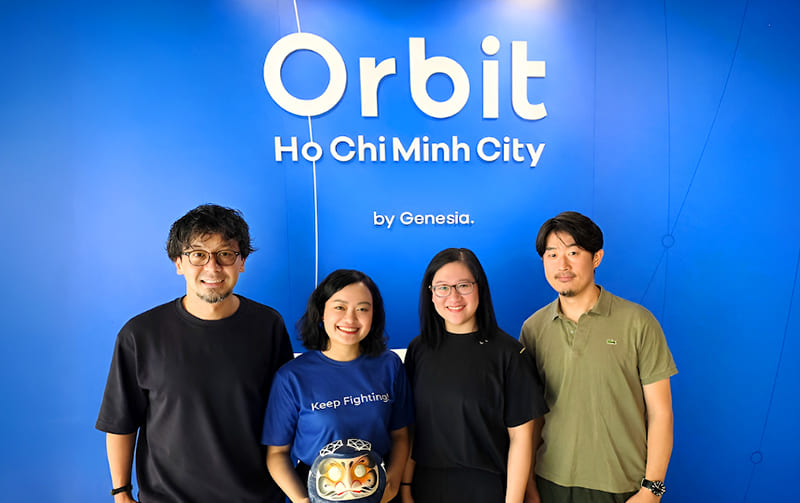
From left: Takahiro Suzuki (General Partner / Head of International Investment), Hoang Thi Kim Dung (Country Director, Vietnam), Elsha Eliasa Kwee (Country Director, Indonesia), Shunsuke Sagara (Country Director, India), Photo credit: Genesia Ventures
How Genesia Ventures Is Redrawing the Cross-Border Investment Map
Southeast Asian startup investment has reached a major inflection point. Following the surge of global VC capital that swept the region in the 2010s — and the ensuing winter that followed — the ecosystem is now entering a qualitatively different phase. Regional giants like Grab and Shopee have moved into the monetization stage, and the question now is how to cultivate the next generation of industry leaders.
Standing at the crossroads of these currents is Genesia Ventures*, founded in 2016. As its name — a blend of "Genesis" and "Asia" — suggests, the firm has placed "co-creation between Japan and Asia" at its core since day one. Today, it operates across four offices in Tokyo, Jakarta, Ho Chi Minh City, and Bengaluru, maintaining an unusually deep commitment to emerging Asian markets for a Japan-based VC. We spoke with General Partner Takahiro Suzuki, who leads the firm's cross-border investment efforts.
Time Machine Is Dead

Photo by el jusuf via Pexels
The "time machine" strategy — importing business models already proven in Japan or the West to capture first-mover advantage — was a powerful playbook Suzuki first engaged with when he served as head of CyberAgent Ventures' (now CyberAgent Capital) Indonesia office from 2011. But when he joined Genesia Ventures in October 2018, that formula was no longer working. With more players and greater maturity, the white spaces had rapidly been filled in.
"Back then, you could map out a vertical and say 'this space will go to this type of company' — it was straightforward. Working through those verticals one by one was the reality of the Southeast Asian market from the mid-2000s to the mid-2010s." (Suzuki)
What drives Genesia Ventures' investment decisions today? Suzuki points to two core themes.
The first investment theme is Compound Startups Fill the Gaps: deliberately combining multiple business layers so that each reinforces the others. In Southeast Asia, where labor costs are low, standalone SaaS faces pricing limitations. What has emerged instead is a structure where business management tools (the SaaS layer) establish touchpoints and trust with customers, then monetize through financial services — payments, credit, and insurance — powered by those accumulated transaction flows.
"In B2B daily consumer goods supply chains, companies often roll out inventory management tools at near-zero cost — without really monetizing there. The monetization comes at the procurement layer, by embedding payment functions and taking a cut of transaction flows. Products that combine software with payments and financial services are simply the norm here." (Suzuki)
What Japan has only recently labeled "compound startups" had long been implemented in Southeast Asia. The structural reason is clear: while DX in Japan typically means "further optimizing processes that are already digitalized," in Southeast Asia it's not uncommon to start from scratch — making business flows visible in the first place. This is why the two-tier structure naturally emerged: deploying the software layer broadly at accessible pricing or even for free, while generating revenue proportional to transaction volume through the financial services layer.
The second investment theme is Tech Ops Meets Real Business: investing in models that embed technology into physical businesses in countries with growing populations, dramatically improving their margins. Concrete examples include Bobobox (hotel operations), Buymed (pharmaceutical distribution), and visa agency operators.
"Every industry's supply chain is full of waste. Our style isn't disruption — it's empowerment, smoothing things out while strengthening what's already there." (Suzuki)
Why Indonesia Alone Won't Win
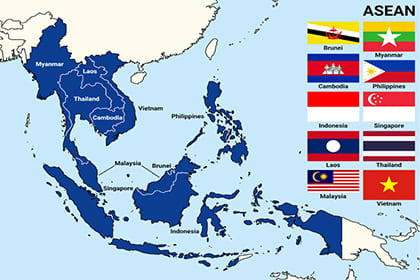
Image by RizkyJogja via Wikimedia Used under the CC BY-SA 4.0 license.
Southeast Asia has a population of roughly 600 million, nearly half of whom live in Indonesia. Not long ago, "if you can scale in Indonesia, there's no need to go elsewhere" was a widely held view among investors. But this Indonesia-first mindset has been significantly undermined by the shifting economics of Grab and Shopee.
Grab built profitable business foundations in Singapore, Malaysia, Thailand, and other markets first, then funneled those profits into competing aggressively in Indonesia. Sea Group's Shopee follows the same playbook. The dramatic fall in valuations for GoTo (the merged entity of Gojek and Tokopedia) and Bukalapak vividly illustrates how hard it is to compete against rivals who can subsidize losses in your home market with profits earned elsewhere.
"Grab is profitable outside Indonesia and pours all of those earnings back into the Indonesian market. More and more companies are winning big outside Indonesia and using those profits to fight there — and as a result, companies focused solely on winning in Indonesia are gradually being squeezed out. That's simply the reality." (Suzuki)
With this competitive environment in mind, Genesia Ventures has from an early stage encouraged its portfolio companies to expand across Southeast Asia as a whole. The key to success isn't simply geographic expansion — it's whether you can leverage the relationships and credibility built in one country as a springboard for others.
Insurtech company Qoala is a prime example. In Indonesia, Qoala built deep partnerships with major insurers, then used those relationships as leverage to expand into Thailand, Malaysia, Vietnam, and the Philippines. Docquity, a digital platform for physicians, became an official partner in the educational programs of the Indonesian Medical Association (IDI), then carried that credibility into partnerships with medical associations in the Philippines and Thailand.
However, in sectors like pharmaceutical supply chains — where regulations and distribution structures differ completely from country to country — the same formula simply doesn't apply. How well leverage works varies greatly depending on the nature of the industry and the domain. Conglomerates hold channels and customer bases but lack technology — when Japanese startups bring in technology and ride the conglomerates' distribution and customer networks, they can scale rapidly. This structure represents a powerful entry path for Japanese technology in Southeast Asia.
Meanwhile, the TSE Asia Startup Hub's vision — Asian startups listing on the Tokyo Stock Exchange and tapping Japan's growth capital — is closely intertwined with this regional expansion strategy. Voices saying "we're considering the TSE as an option" have begun to emerge among startups in Taiwan and Singapore.
One is "market psychology." For Japan's retail investor base, Southeast Asian companies remain unfamiliar, and whether companies can carefully articulate the narrative of "why investors should hold this stock" has a real bearing on listing viability. The other is talent scarcity. CFOs and administrative leads who are bilingual in Japanese and English and capable of driving the listing process are rare even among Japanese startups.
"The capability is there in theory; the people just aren't. We need to develop more people with those skills. It really comes down to how many people who are truly grinding through this in the field we can grow. We're not there yet." (Suzuki)
How to Win in Southeast Asia

In June 2024, Genesia Ventures opened a shared office called Orbit in Ho Chi Minh City, Vietnam. Photo credit: Genesia Ventures
Indonesia-based Qoala has grown to become the dominant player in Southeast Asia's insurtech space. MUFG Innovation Partners has invested as a Japanese institutional backer, while Tokio Marine and Mitsui Sumitomo Insurance participate as product development and sales channel partners. As Japan's major non-life insurers pursue Asian expansion as a medium-term strategic priority, Qoala — through its integration with travel agency solution Opsigo (used by Indonesia's top 100 travel agencies) — functions as a sales channel for the overseas travel insurance that Indonesian nationals are required to hold when traveling abroad.
Docquity is a TSE Asia Startup Hub first cohort company (Singapore entity) that has expanded its digital platform for physicians across Southeast Asia and into the Middle East, Taiwan, and South Korea. With Itochu Corporation as a shareholder, it is one of the companies for which a path to a TSE listing is relatively easy to map out. Its strategy of rapidly onboarding the physician "supply side" through official partnerships with medical associations is highly replicable in new markets. Rather than being simply a "social network for physicians," it has layered multiple revenue streams — MR activity support, patient referral flows, and more — which strengthens its long-term growth potential.
Movus Technologies is a vehicle leasing-like service for ride-share drivers founded by a Japanese entrepreneur in Indonesia. While demand for individual drivers has surged with the spread of Grab and Gojek, vehicle acquisition remains a significant barrier to entry for many drivers.
Vietnamese BNPL leader Fundiin has completed a major fundraising round and is capturing youth consumption demand in Vietnam's market where credit card penetration remains low.
Indonesia's daily consumer goods supply chain company Sinbad is a textbook compound model: it provides inventory management SaaS at near-zero cost to wholesale distributors, then monetizes by embedding payment and credit functions into the procurement flows those tools generate. Logistics platform Logisly goes beyond shipper-carrier matching to reduce logistics costs through load efficiency optimization, earning fees from those improvements.
Buymed, operating pharmaceutical distribution in Vietnam, Thailand, and Cambodia, has grown on the strength of its proprietary distribution network and credit data. Because pharmaceutical regulations and distribution routes vary widely by country, its first-mover advantage in each market forms a barrier to entry that rivals cannot easily replicate.
Indonesia's Bobobox identified the shortage of mid-range hotels and built a model that integrates both property operations and online booking functions. By achieving high margins through tech-driven operational efficiency while benefiting from the tailwinds of population growth and an expanding middle class, it embodies the real business model.
Connecting Japan and Asia

Sinarmas Land Plaza Photo by Tom Fisk via Pexels
A new ecosystem development Suzuki has been watching closely is the formation of a fund centered on Indonesia's top conglomerate Sinarmas Group. Living Lab Ventures — the CVC arm of Sinarmas Land, the real estate division of Sinarmas Group — and Singapore-based Spiral Ventures jointly launched the "Sinarmas Spiral Japan Theme Fund," which held its signing ceremony in November 2025. The target fund size is $100 million. Investors include the Cool Japan Fund, Bank Danamon (part of the MUFG Group), and Rohto Pharmaceutical. The fund is designed to advance two things in parallel: investing in Japanese tech startups, and implementing their technologies in Indonesia.
The logic of this fund is the flip side of the conglomerates' structural characteristic of "having markets and channels but no technology." Sinarmas Land is developing smart cities across Indonesia, and there are many Japanese technologies that could be deployed there. Suzuki points to examples like Zip Infrastructure (a gondola-style urban transit developer; not a Genesia Ventures portfolio company) and energy management combining battery storage with electricity trading. Deal-by-deal matchmaking with Japanese corporates is also working in practice.
For Indonesian and Vietnamese startups, Japan represents "market appeal: yes" — but the reality is that the language barrier prevents them from building real market clarity. While English-speaking executives can be interviewed to understand other markets, information about Japan's corporate sectors is only available in Japanese. While startups from Taiwan and Singapore are increasingly treating Japan as a concrete expansion target, for those from Indonesia and Vietnam it remains closer to "appealing in theory, but the entry point isn't clear."
Structural mismatches also exist due to differences in industry composition and market maturity. Business models that work in Southeast Asia don't necessarily translate to Japan, and whether products and strengths that work locally will succeed in the Japanese market is a separate question. Conversely, if more players emerge who can overcome this language and information barrier, the entry barrier to the Japanese market would drop dramatically. Both the TSE Asia Startup Hub initiative and Genesia Ventures' emphasis on outreach are, at their core, acts of "lowering the wall."
Genesia Ventures' future direction, as Suzuki describes it, rests on two pillars.
The first is deepening its bridge function connecting large Japanese corporates with Southeast Asian startups. While Japan's brand credibility still holds in Southeast Asia, the firm wants to build real track records of transactions and operational collaboration beyond mere introductions.
The second is bridging Japanese deep tech startups into Southeast and East Asia. The firm currently allocates roughly 20% of its total investments to deep tech, and is already working to accelerate partnerships between its Japanese portfolio companies and companies across Southeast Asia.
"Ideally, we'd be running alongside startups and large companies that are redefining industries together, supporting them as they complement each other. Japanese deep tech startups tend to generate better technology synergies with Southeast and East Asian companies — Korean and Taiwanese large enterprises — than they do domestically. If we can be the hub for that, I think it would be really interesting." (Suzuki)
Japanese deep tech companies face a persistent problem: enterprise adoption takes a long time, and companies often run out of runway waiting. But conglomerates in Southeast Asia and large corporations in East Asia often make decisions far more quickly — and counterintuitively, building a track record in Asia before Japan may be the more viable path, according to Suzuki. Seizing these structural opportunities not only as investors but as a hub for talent, networks, and information, Genesia Ventures continues its challenge to grow the "cross-border threads" strung across Asia into something much thicker and more durable.
This article is a summary of the interview published on Growthstock Pulse. See also the full interview: Part 1 and Part 2.
