

Environmental Information (TCFD Disclosure/Transition Plan)
Environmental Vision and Policy
Recognizing that resources are limited, JPX has created its Environmental Vision and Environmental Policy to aim for a sustainable economy where “economic development” and “environmental conservation” go hand in hand.
Environmental Vision
Japan Exchange Group will maintain and further develop the capital market into one that can coexist with the environment, by creating a clear action plan on environmental issues and making ongoing efforts to reduce our environmental footprint.
Environmental Policy
| 1. Contributing to a decarbonized economy |
We will contribute to the decarbonization of the economy by eliminating 100% of our own GHG emissions. |
| 2. Contributing to a circular economy |
We will contribute to the development of a circular economy by reducing our resource consumption and waste output, as well as promoting green procurement. |
| 3. Strong management of environmental policy |
Recognizing action on the environment as an important management issue, we will continue to comply with all related laws, regulations and rules, and in addition, will enact dialogue with stakeholders and society through proactive disclosure of environmental information. |
| 4. Encouraging environmental conservation initiatives |
We will encourage environmental conservation initiatives across the whole of society through education to cultivate awareness of environmental issues. |
Contributing to a decarbonized economy
Towards carbon neutrality
In July 2021, JPX set a target of carbon neutrality by FY2024, covering direct and indirect emissions in its own operations (Scopes 1 and 2), and since then has worked towards reducing its greenhouse gas (GHG) emissions. For electricity consumption, which is the main source of its emissions, JPX switched 100% of electricity consumed by the group to renewable energy through a combination of various procurement methods (switching electricity contracts, PPAs, etc.) depending on the electricity demand at each site. In addition to this, it is building a renewable energy portfolio with a longer-term outlook by incorporating procurement methods that minimize reliance on external factors, such as use of JPX-specific renewable energy generation facilities.
GHG emissions which cannot be reduced through renewable energy usage (Scope 1 and non-electricity-based Scope 2) are offset through J-Credits.
From FY2025, JPX will continue its initiatives with the target of maintaining carbon neutrality in Scopes 1 and 2 as well as curbing emissions on an ongoing basis through appropriate emissions management, including for Scope 3.
Targets for carbon neutrality
FY2024: Achieve carbon neutrality in Scopes 1 and 2 (achieved)
From FY2025: Maintain carbon neutrality in Scopes 1 and 2; curb emissions including Scope 3 on an ongoing basis
JPX-specific renewable energy generation facilities
To contribute to procurement of the renewable energy that enables JPX's carbon neutrality, several JPX-specific renewable energy generation facilities are in operation. JPX allocates renewable energy generated by 21 plants, all located in Japan, to its various sites depending on the volume of energy generated by and the location of each plant.
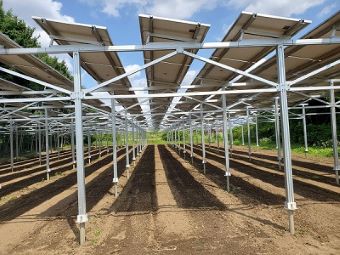
Ibaraki Prefecture, online from August 2022
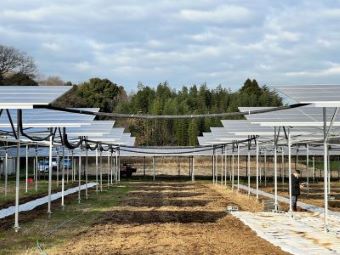
Chiba Prefecture, online from October 2022
These JPX-specific facilities include three solar power plants (two pictured above) that coexist with agriculture on farmland. JPX is looking to contribute to a decarbonized and circular economy by utilizing mainly idle or discarded farmland for power generation.
Some of the solar power plants also utilize reused solar panels which had been disposed of for reasons such as natural disasters.
Strong management of environmental policy
Medium-Term Management Plan
JPX takes its Environmental Vision and Policy into account when formulating its management strategy.
The Medium-Term Management Plan 2024 (FY2022-FY2024) was positioned as the first stage towards achieving JPX's long-term vision for 2030: "contribute to sustainable societal and economic development by evolving into a global, comprehensive finance and information platform which provides solutions for a wide range of societal issues, centered on the ability to raise and circulate capital." As part of this Plan, JPX set out and advanced its "Green Strategy."
In the Medium-Term Management Plan 2027 (FY2025-FY2027), positioned as the second stage, JPX will build on the foundations laid out in the first stage, having set "addressing climate change" as one of its "key areas from the perspective of sustainability."
Key Areas From the Perspective of Sustainability: Addressing Climate Change
When maintaining and strengthening its IT infrastructure to ensure the safety and fairness of transactions, or taking on challenges in new business areas, including digital transformation, JPX Group considers the efficient use and streamlining of energy, which could otherwise have an impact on climate change, to be an important mission.
JPX also sets out a commitment to contributing to a decarbonized economy in the Environmental Policy that it formulated recognizing that resources are limited, and is working on initiatives toward achieving carbon neutrality for Japan as a whole.
Even in areas where there are limits to what it can contribute as a company, JPX Group provides support for the transition to decarbonization by offering solutions that leverage market mechanisms, such as the development of a market for emissions trading and the raising and circulation of capital through the handling of related products.
For more about the key areas from the perspective of sustainability, please see the below page.
Disclosure in line with the TCFD Recommendations
JPX discloses environmental information in line with the TCFD Recommendations. Please see the TCFD disclosure page.
Response to CDP
Below is JPX's latest response to CDP, from 2025. This received a score of B.
| JPX CDP Response 2025 |  |
|---|
| Mapping of Information Relating to Transition Plan in CDP Response | |
|---|
Information for the Net Zero Exchange Group
JPX joined the Net Zero Exchange Group in December 2023. This is a global group of exchanges committed to supporting the goal of global net zero greenhouse gas emissions by 2050 or sooner, in line with the ambition to limit the global temperature increase to 1.5°C above pre-industrial levels.

Member exchanges of the Net Zero Exchange Group are required to publish information annually about their activities in regard to these commitments. Please find information about JPX's activities below.
As a corporate entity (exchange-focused)
| Focus Area | NZFSPA Target | JPX Initiatives | References |
|---|---|---|---|
| Governance | 1.Exchanges should put appropriate governance structures in place to ensure accountability for and oversight of the development and execution of the commitments. | Recognizing that addressing climate change is an important management issue, JPX Group has established a Sustainability Committee, with the Group CEO serving as Chair and the Group COO as Vice-Chair. The committee has analyzed how related issues affect business operations and is proceeding to address these. The Group has also established a system for adequately reporting basic policies and important matters associated with climate change to the Board of Directors, which in turn provides oversight of those basic policies and important matters as appropriate. Specific activities:
|
Annual Securities Report FY2024 (pp. 18, 63, 95) Medium Term Management Plan 2027 (p. 10) JPX Report 2025 (pp. 33-36) Corporate Governance TCFD Disclosure/Transition Plan Environmental Activities Response to Risk Management CDP Response 2025 (pp. 47, 13-18) |
| 2.Exchanges should ensure that relevant policies, procedures and training are implemented to support its efforts. | In order to “contribute to the realization of an affluent society by promoting sustainable development of the market” as set out in its Corporate Philosophy, the Group works on initiatives to improve its corporate value with attention to the surrounding environment and societal issues and the Group’s relationship to them. The Group considers this an important management issue and formulates its management policies and plans accordingly. Specific activities:
|
JPX Report 2025 (pp. 33-36) Medium Term Management Plan 2027 (p. 10) Environmental Activities JPX ESG Knowledge Hub "Practical Seminars for ESG Disclosure" CDP Response 2025 (pp. 17-18) |
|
| Emissions reductions & disclosure | 1.Exchanges should publicly disclose their climate actions annually as part of a transition plan. | JPX has formulated a transition plan in reference to the TCFD Consortium's "Transition Plan Guidebook" and other guidelines and has published this using the framework of the TCFD Recommendations. Specific activities:
|
TCFD Disclosure/Transition Plan |
| 2.Exchanges should measure and disclose their Scope 1, 2 and (where material) 3 emissions annually. | JPX has been calculating and publishing its Scope 1 and 2 GHG emissions since FY2019 and Scope 3 since FY2020. Specific activities:
|
Environmental Data JPX Report 2025 (p. 64) CDP Response 2025 (pp. 114-124) |
|
| 3.Exchanges should commit to Scope 1, 2 and (where material) 3 emission reductions for their own operations. | JPX Group has reviewed its approach to procuring electricity, which is the primary factor in its emissions. As a result of this move, JPX Group has switched 100% of electricity consumed throughout the Group to renewable energy and achieved carbon neutrality (Scopes 1 and 2) across Group companies as of FY2024. The Group also calculates other CO2 emissions (Scope 3) and works to reduce GHG emissions while appropriately managing emissions throughout the value chain. Specific activities:
|
Environmental Data Environmental Activities JPX Report 2025 (p. 49) CDP Response 2025 (pp. 114-124) |
As an exchange operator (market-focused)
| Focus Area | NZFSPA Target | JPX Initiatives | References |
|---|---|---|---|
| Transparency & education | 1. Exchanges should actively promote availability of high-quality climate information by producing guidance for issuers or undertaking initiatives that encourage climate-related disclosure (as may be relevant to the market). | JPX is engaged in activities to promote sustainable activities and sustainability information disclosure among listed companies in cooperation with related parties both domestic and global. Specific activities:
|
Corporate Governance Code Support for ESG Information Disclosure ESG Bond Information Platform |
| 2.Exchanges should offer climate disclosure training at least annually. | JPX works to provide information to listed companies through webinars and other means to promote disclosure in line with the TCFD Recommendations. Specific activities:
|
JPX ESG Knowledge Hub "Practical Seminars for ESG Disclosure" ISSB page (in Japanese) CDP Response 2025 (pp. 91-92) TCFD Consortium "Transition Plan Guidebook" Seminar with FTSE Russell (in Japanese) Seminar on S&P/JPX Carbon Efficient Index (in Japanese) |
|
| Products & services | 1.Exchanges should work to raise visibility for climate-themed products. | As well as providing climate-themed products, JPX works to raise visibility of these products among institutional and individual investors. Specific activities:
|
JPX Report 2025 (pp. 33-36) ESG-related products TSE Manebu ESG/SDGs (in Japanese) ESG Bond Information Platform TOCOM Partners With Tokyo Metropolitan Government on Trial Trading of Green Hydrogen Carbon Credit Market CDP Response 2025 (p. 93) |
| 2.Exchanges should incorporate climate-related considerations into the development processes for products and services. | Under the key areas from the perspective of sustainability set out in the Medium-Term Management Plan, "promoting sustainable finance" and "addressing climate change," JPX looks to provide information services and other market mechanisms that will contribute to, for example, enhancing accessibility of climate-related information for investors and supporting the transition to decarbonization. Specific activities:
|
JPX Report 2025 (pp. 33-36) |
|
| Policy, persuasion & engagement | 1.Exchanges should actively engage with local and global policy makers and standard setters to stay informed of and promote net zero aligned policies. | JPX is supporting the transition to a decarbonized economy through cooperation with related parties both domestic and global. Specific activities:
|
CDP Response 2025
(pp. 59-60, 98-99) Seminar series with IFRS (Japanese) |
| 2.Exchanges should work towards mandatory climate-related disclosure in their markets. | In January 2023 the Japanese government amended the Cabinet Office Ordinance on Disclosure of Corporate Affairs, etc. to add an "Approach to Sustainability and Related Initiatives" section in said reports for disclosure of climate and other sustainability-related information. From March 2023, a "Working Group on Disclosure and Assurance of Sustainability-related Financial Information" under the FSA's Financial System Council is discussing the possible incorporation in statutory disclosures of the SSBJ standards, which are being formulated based on those from the ISSB, along with potential rules on assurance. Specific activities:
|
JPX ESG Knowledge Hub |
|
| 3.Exchanges should proactively engage with market participants, including through market awareness programmes, to promote the adoption of net zero commitments and transition plans among market participants. | JPX is supporting the transition to a decarbonized economy through cooperation with related parties both domestic and global. Specific activities:
|
CDP Response 2025
(p59-60, 98-99) Carbon Credit Market JPX Announces Endorsement of METI's "GX League Basic Concept" Initiatives supported by JPX |
Encouraging environmental conservation initiatives
Tree-planting program
The TSE Listing Forest began in June 2004 in Yurihonjo, Akita Prefecture. We carry out ongoing conservation activities at the7.3-hectare plot, including planting, weeding, and installing protection over winter in the hope that the exchange will grow and prosper along with the planted trees. To mark its 20th anniversary in 2024, we held a tree-planting ceremony, lectures, and other commemorative events in September together with local residents.
This project has also been certified for 63.7t of CO2 absorption (FY2024) under Akita Prefecture's "Akita Forestry: Carbon Dioxide Absorption Through Forest Development Certification System."
Together with these conservation activities, JPX has worked alongside the local Yashima region, which has cooperated on these activities, in providing financial education. JPX offers on-site courses about how stock companies work at Yurihonjo Shiritsu Yashima Elementary School, Yurihonjo Shiritsu Yashima Junior High School and Akita Prefectural Yashima High School. An NPO established to run the JPX Entrepreneur Program under its own direction has initiated projects - for example at Akita Prefectural University and Akita Prefectural Nishime High School - with the collaboration of industry, academia, government, and financial sectors. The NPO has developed a finance and economics education program integrated throughout the local community, to the extent that in February 2019 it won an award from the Government’s Small and Medium Enterprise Agency.